


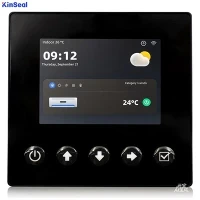


Industrial control computer is a kind of computer system specialized in the field of industrial automation, and its structural characteristics are mainly reflected in the following aspects:
Reliability
Industrial control computers need to operate stably for a long time in harsh industrial environments, so their hardware and software are designed with high reliability. For example, industrial control computers usually use industrial-grade chips and components, with high anti-interference capability and stability. At the same time, its software system has been rigorously tested and verified to ensure that it can operate normally under various working conditions.
Validity
Industrial control computers need to monitor and control the production process in real time, so it has a high degree of real-time. This is mainly reflected in the following aspects:
Fast response: industrial control computers can quickly respond to external input signals to achieve real-time control of the production process.
Precise control: industrial control computers can accurately control a variety of production equipment to ensure the stability and consistency of the production process.
Multi-tasking: industrial control computers can handle multiple tasks at the same time, realizing the cooperative control of multiple production equipment.
Modular design
Industrial control computers are usually modular design, can be flexibly configured according to different application requirements. Modular design has the following advantages:
Easy to expand: modular design makes the industrial control computer can be increased or reduced according to the need to increase or decrease the module, convenient for functional expansion.
Easy to maintain: modular design makes each module independent of each other, easy to carry out troubleshooting and maintenance.
Easy to upgrade: modular design makes industrial control computers can be upgraded according to the technological development of the module to improve system performance.
Highly integrated
Industrial control computers are characterized by a high degree of integration, integrating a variety of functions in a single device, improving the integration and reliability of the system. For example, industrial control computers usually integrate the following functions:
Control function: to realize the control and scheduling of production equipment.
Communication function: to realize data exchange and communication with the upper computer, lower computer and other devices.
Display function: real-time display of various parameters and status of the production process through the touch screen or monitor.
Data processing function: process and analyze the collected data to provide the basis for production decision-making.
Powerful data processing capability
Industrial control computers have powerful data processing capabilities, able to handle large amounts of data and perform complex calculations. This is mainly reflected in the following aspects:
High-performance processor: industrial control computers usually use high-performance processors, with high computing speed and processing power.
Large-capacity storage: industrial control computers have a large storage capacity, can store a large amount of data and programs.
High-speed data transmission: industrial control computers have high-speed data transmission capability, which can quickly process and transmit data.
Rich interface
Industrial control computers have rich interfaces, which can be easily connected and communicated with other devices. Common interfaces include:
Serial interface: used to communicate with serial devices, such as RS-232, RS-485 and so on.
Parallel Interface: Used to communicate with parallel devices, such as Centronics, IEEE 1284, etc.
Network Interface: Used to communicate with network devices, such as Ethernet, wireless network, etc.
Fieldbus Interface: Used to communicate with fieldbus devices, such as Profibus, Modbus, etc.
Analog signal interface: used to communicate with analog signal devices, such as analog input/output interface.
Good human-computer interaction
Industrial control computers have good human-computer interaction performance, and can easily interact with the operator. Common human-computer interaction methods include:
Touch screen: operation and control through the touch screen to achieve intuitive and convenient interaction.
Keyboard and mouse: through the keyboard and mouse for operation and control, to achieve flexible and efficient interaction.
Display: Various parameters and status of the production process are displayed through the display, realizing real-time and accurate interaction.
High security
Industrial control computers have a high degree of security to prevent malicious attacks and data leakage. Common security measures include:
Firewall: Prevent malicious attacks and data leakage through firewalls.
Encryption: Protect the security and integrity of data through encryption.
Access Control: Restrict access to systems and data through access control to prevent unauthorized access.
Energy saving and environmental protection
Industrial control computers are designed with full consideration of the requirements of energy saving and environmental protection, with lower energy consumption and smaller size. This is mainly reflected in the following aspects:
Low-power design: industrial control computers use low-power processors and components to reduce energy consumption.
Thermal design: industrial control computer adopts reasonable heat dissipation design to ensure stable operation of the system even in high temperature environment.
Miniaturized design: industrial control computer adopts miniaturized design to reduce the size and weight, which is easy to install and carry.
Easy to program and develop
Industrial control computers are characterized by easy programming and development, supporting a variety of programming languages and development tools. This allows developers to quickly develop applications to meet specific needs and improve development efficiency.
In short, the structural characteristics of industrial control computers are mainly reflected in high reliability, real-time, modular design, highly integrated, powerful data processing capabilities, rich interfaces, good human-computer interaction, a high degree of security, energy saving and environmental protection, as well as easy programming and development.