


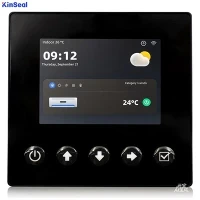


VariableFrequencyControl (VFC) refers to adjusting the rotational speed of a motor's rotor to change the power and speed it delivers. VariableFrequencyControl can achieve a variety of control methods such as motor starting and stopping, acceleration, deceleration, reversal and equal-speed operation, and can be finely adjusted and optimized through software. Usually, the frequency converter will convert the power supply DC to AC, and by adjusting the frequency of AC, the speed and efficiency of the motor can be controlled. Inverter control technology has been widely used in industrial control, blue-collar intelligent manufacturing and other fields, and plays an important role in improving production efficiency, energy saving and consumption reduction, and improving the stability of equipment operation.
The main role of variable frequency control is to realize the precise control of the motor running speed by changing the power supply frequency and voltage of the driving motor, so as to be able to meet the changes in the motor speed and load requirements of various production processes. Inverter control is generally used in the following aspects:
1. Energy saving and consumption reduction: through the frequency converter to change the input power supply frequency and voltage ratio of the drive motor, to achieve the effect of reducing the motor start-up current, reduce load inertia, reduce motor energy consumption and so on.
2. Precise control: frequency conversion control can realize real-time control and adjustment of the running speed and load of the motor, so that it can precisely respond to the dynamically changing demands in the production process.
3. Torque increase: when the need to start a large load, increase the torque of the occasion, the use of frequency converters to reduce the starting current, to achieve a smoother start, less load impact, and extend the service life of electrical equipment.
4. Production automation: frequency converter can be integrated into industrial production to realize automation control and improve factory production efficiency and quality.
5. Reduction of mechanical failure: due to the precise control of the frequency converter controller, the wear and tear of mechanical parts and failure rate is greatly reduced, prolonging the service life of the motor and equipment.
Inverter control is used in a wide range of applications in fields such as food and beverages, chemicals, textiles, printing and shipbuilding. The use of frequency converters can bring about a great deal of change in an organization, including effects such as increased productivity, reduced maintenance costs for industrial equipment in use, and a significant reduction in energy consumption.