

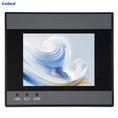
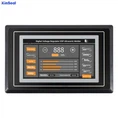


With the development of computer and control technology, the traditional industrial control technology has been gradually replaced by intelligent control technology, the development of intelligent industrial control system for the development of the industrial field provides the strongest technical guarantee, is to promote the development of enterprises to continue innovation and development of an effective way. China is the world's largest demand for human-machine interface market, but not the world's highest sales of human-machine interface products. In the domestic automation industry, some industries that originally did not use HMIs have started to use them, which shows that HMIs have become an indispensable part of the customer experience. The user interface of HMIs can better reflect the state of equipment and processes, and bring customers a more intuitive feeling through the effects of vision and touch.
Some machinery industries, such as machine tools, textile machinery, electronic equipment and other industries, has been developed in the country for decades, relatively speaking, belongs to a more mature industry, in the long run, these industries also exist in the demand for upgrading equipment. In this upgrading process, it is true that there will be some small, has been using relatively low-end products manufacturers were eliminated, but there are also many companies in the process of equipment renewal, the demand will be repositioned to look for those who are able to meet their development plans, to help them improve their own productivity of the equipment suppliers.
In view of this demand, the future of the human-machine interface will change in shape, concepts, applications and other aspects of the change, which will bring about a change in the core technology of industrial control machines. In general, the future development trend of human-machine interface is six modernization: platform embedded, brand nationalization, equipment intelligence, interface fashion, communication network and energy saving and environmental protection.
The relationship between human-computer interface and industrial intelligence
Intelligent industry: It is the continuous integration of various types of terminals with environment sensing ability, computing mode based on ubiquitous technology, mobile communication and so on into all aspects of industrial production, which significantly improves manufacturing efficiency, improves product quality, reduces product cost and resource consumption, and upgrades the traditional industry to a new stage of intellectualization. In general, the realization of intelligent industry is based on the penetration and application of Internet of Things (IoT) technology, and combined with future advanced manufacturing technology to form a new intelligent manufacturing system.
The traditional industrial automation control system mainly consists of three levels, namely, device layer, control layer, and information layer. The function of the device layer is to connect the field equipment in the form of network nodes on the fieldbus network, in accordance with the fieldbus protocol standard, the device adopts the structure of the function module, through the configuration design, to complete the data acquisition, A/D conversion, digital filtering, temperature and pressure compensation, PID control and other functions; the control layer is the basis of automation, to obtain the data from the field equipment, to complete a variety of control, monitoring, alarms and trend analysis of the operating parameters, and the control layer is the basis of automation. Control layer is the foundation of automation, obtaining data from field equipment, accomplishing various control, operation parameter monitoring, alarm and trend analysis, etc. The functions of the control layer are generally accomplished by controllers such as industrial computers or PLCs, which are equipped with the network capability to coordinate the data communication between network nodes, and at the same time, also realizing the connection between the fieldbus network segment and the Ethernet segment; the third layer of the information layer provides a platform to realize the remote control and connects with the enterprise automation system, and at the same time, extracts relevant production The third information layer provides a platform to realize remote control and connects to the enterprise automation system, and extracts the relevant production data from the control layer for making comprehensive management decisions.
From another point of view, the Internet of Things can make the so-called automation and information technology, "fusion of the two" vision more concrete to achieve, the automation industry has long been towards the goal of information technology, based on the Internet of Things, the original traditional C/S (Client/Server) architecture can be converted to B/S (Browser/Server) architecture, in manufacturing, Intelligent buildings, new energy, environmental monitoring, and equipment control have a wider range of applications. Specifically, if the automation data is not integrated by messaging, the general users still cannot use it; similarly, if there is only messaging function, but lack of automation content, it is also useless.
Combined with future advanced manufacturing technology is the vitality of the Internet of Things applications. The Internet of things is a new round of information and communication technology development of the high point, is widely penetrated in the industrial field and application, and with the combination of future advanced manufacturing technology, the formation of a new intelligent manufacturing system. This manufacturing system is still under continuous development and improvement. To summarize, the combination of Internet of Things and advanced manufacturing technology is mainly reflected in eight areas.
Ubiquitous sensing network technology Ubiquitous manufacturing information processing technology Virtual reality technology Human-computer interaction technology Spatial collaboration technology Parallel management technology E-commerce technology System integration manufacturing technology
As a whole, industrial intelligence is still in its infancy. The large-scale application of industrial intelligence in the industrial field is still facing some key technical problems, which are summarized in the following aspects.
Industrial sensors Industrial wireless network technology Industrial process modeling
In addition, the large-scale application of industrial intelligence in the industrial field is also facing key technical issues such as industrial integrated service agent bus technology and industrial semantic middleware platform.
The basis of industrialization is automation, the automation field has been developed for nearly a hundred years, the theory, practice have been very perfect. Especially with the rise of modern large-scale industrial production automation and process control requirements of the increasingly complex operation of the DCS control system, it is a combination of computer technology, system control technology, network communications technology and multimedia technology, the DCS concept is decentralized control, centralized management. Although the automatic equipment all networking, and can monitor the information in the control center and through the operator to centralized management. However, the level of the operator determines the degree of optimization of the entire system. Experienced operators can optimize the production, while inexperienced operators only ensure the safety of the production. Is there a way to decentralize control and centralize optimization? The need to find the optimal control method through the Internet of Things based on all the monitoring information, through analysis and optimization technology is what the Internet of Things can bring to the DCS control system.
Today, such as images, voice signals and other large amounts of data, high speed transmission requirements, giving rise to a combination of Ethernet and control networks, networking wave will be such as embedded technology, multi-standard industrial control network interconnections, wireless technology, and other emerging technologies into the integration, thus expanding the development of industrial control space, bringing new opportunities for development. Intelligent industrial control is growing rapidly.
Human-computer interaction is a product of the combination of computer science and cognitive psychology, but also involves human ergonomics, sociology, physiology, medicine, linguistics, philosophy and many other disciplines, is a highly integrated science, so the knowledge structure of the researchers requires a high level of researchers, need to have a deep experience in industrial automation, the human-computer interface has a unique understanding of the research and development enterprises. Various industries are booming, manufacturing, IT industry, automobile industry, etc. all need design. And these designs should not only look good, but also work well. Nowadays, people not only have to deal with machines, but also with objects and automobiles, all of which require human-machine interfaces. Therefore, many people are now starting to study the human-machine interface, which is a very important part of all kinds of innovation, and it touches the very core of innovation.
As a leading manufacturer of IoT smart devices, Tatsuhan Electronics has strongly felt that intelligent HMI products are facing great opportunities and challenges. On one hand, high-performance embedded processors such as single-core to multi-core high-end ARM processors and intelligent operating systems such as Android have penetrated into all aspects of people's lives, and along with them, industrial smart products are also increasingly in need of better Along with this, industrial smart products are also increasingly in need of better user experience, higher performance, lower power consumption, cheaper price, and seamless connection to cell phones, desktops, and the cloud. Traditional closed windows applications based on x86 or low-end ARM architecture can no longer meet the needs of developers and integrators. The tip of the iceberg of the industrial Internet has just opened, and I believe that the new generation of android-based human-computer interaction products are bound to bring users an extraordinary experience and realize great value.