




The industrial robot control cabinet is the core component of an industrial robot system, which is responsible for receiving commands from the operator or the automation system and controlling the robot's movement and work. The design and manufacture of the control cabinet is critical to the performance, stability and reliability of the robot. In this paper, we will introduce the composition of the industrial robot control cabinet in detail, including both hardware and software.
I. Hardware Composition
Power module
Power supply module is the energy supply part of the control cabinet, which is responsible for converting the input AC power into DC power required by the robot. Power supply module usually includes rectifiers, filters, voltage regulators and protection circuits. The rectifier converts the AC power into pulsating DC power, the filter eliminates the ripple in the pulsating DC power, the voltage regulator ensures the stability of the output voltage, and the protection circuit protects the power supply module in the event of an abnormality.
Controller
The controller is the core component of the control cabinet, which is responsible for receiving commands from the operator or the automation system, calculating the robot's trajectory and speed, and controlling the robot's various joints and actuators. The controller usually includes the main controller, motion controller and I/O interface. The main controller is responsible for processing high-level commands and coordinating the work of various subsystems, the motion controller is responsible for realizing the motion control of the robot, and the I/O interface is responsible for communicating with external devices.
Driver
The driver is the power output part of the control cabinet, which is responsible for converting the controller's commands into the driving force of the robot's various joints and actuators. Drives usually include servo drives, stepper drives and DC drives. Servo drives are characterized by high precision, high response speed and high stability, and are suitable for high-precision and high-speed robot applications; stepper drives are characterized by simple structure, low cost and easy control, and are suitable for low-speed and low-precision robot applications; DC drives are characterized by high torque, high efficiency and high reliability, and are suitable for heavy-duty and large-scale robotic applications.
Sensors
Sensors are the sensing part of the control cabinet, which is responsible for detecting the robot's motion status, position, speed, torque, and other information, and feeding this information back to the controller. Sensors usually include encoders, torque sensors, tactile sensors, vision sensors, etc. Encoders are used to detect the angle and speed of the robot joints, torque sensors are used to detect the torque of the robot joints, tactile sensors are used to detect the contact state between the robot and the object, and visual sensors are used to obtain the visual information of the robot's working environment.
Communication Module
The communication module is the information transmission part of the control cabinet, which is responsible for transmitting information from inside the control cabinet to external devices or from external devices to inside the control cabinet. The communication module usually includes Ethernet module, serial communication module, wireless communication module and so on. Ethernet module is used to realize the connection between the control cabinet and industrial Ethernet, serial communication module is used to realize the connection between the control cabinet and serial devices, and wireless communication module is used to realize the connection between the control cabinet and wireless devices.
Human Machine Interface
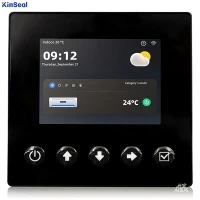
The HMI is the operating part of the control cabinet, which is responsible for inputting the operator's commands into the control cabinet and displaying the status information of the control cabinet to the operator. The HMI usually consists of a touch screen, keyboard, mouse, indicator lights, display, and so on. The touch screen and keyboard are used to input the operator's commands, the mouse is used to realize precise operation, the indicator light is used to show the working status of the control cabinet, and the display screen is used to show detailed information of the control cabinet.
Safety module
The safety module is the protective part of the control cabinet, which is responsible for protecting and alarming the robot in case of abnormal or dangerous situations. The safety module usually consists of an emergency stop button, a safety door switch, a safety light curtain, etc. The emergency stop button is used to protect the robot in case of an abnormal or dangerous situation. The emergency stop button is used to stop the movement of the robot immediately when an abnormality occurs, the safety door switch is used to detect whether the safety area of the robot has been intruded or not, and the safety light curtain is used to detect whether there is any person or object in the working area of the robot.
II. Software Composition
Operating system
The operating system is the basis of the control cabinet software, which is responsible for managing the hardware resources of the control cabinet and providing an environment for software operation. Common operating systems include real-time operating system (RTOS), embedded operating systems (such as Linux, VxWorks, etc.) and general-purpose operating systems (such as Windows, macOS, etc.).
Robot Programming Languages
A robot programming language is a programming language used to write robot control programs that are easy to understand and write, easy to debug and maintain. Common robot programming languages include C/C++, Python, Java, etc.
Robot Kinematics and Dynamics Library
Robot kinematics and dynamics libraries are software libraries used to compute the trajectory and velocity of a robot, which include forward kinematics, inverse kinematics, dynamics modeling, and so on. These libraries can simplify the writing of robot control programs and improve the reliability and stability of the programs.
Robot control algorithms
Robot control algorithms are algorithms used to realize robot motion control, which include PID control, adaptive control, fuzzy control and so on. These algorithms can automatically adjust the control parameters according to the actual motion state and working environment of the robot to realize precise and stable control.
Robot communication protocol
Robot communication protocols are protocols used to realize the communication between the control cabinet and external devices, which include Modbus, Profibus, EtherCAT and so on. These protocols can ensure the reliability and real-time communication, and improve the compatibility and expandability of the robot system.