


A frequency converter (VFD) and a soft starter are two distinct electrical devices, with the following key differences between them:
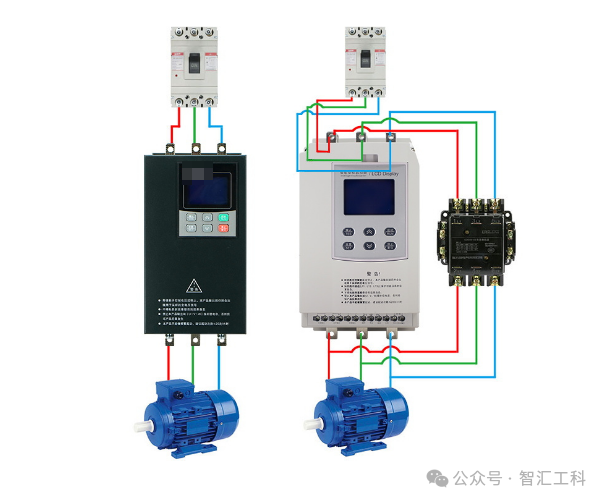
I. Functions and Applications
1. Soft Starter
- Core Functions: Mainly used to reduce the current inrush during motor startup and achieve smooth starting. It can make the motor starting current rise steadily from zero to the set value by gradually increasing the conduction angle of the thyristor, thus avoiding the generation of inrush current.
- Application Scope: Generally suitable for occasions with low requirements for starting torque, such as metallurgy, petrochemical industry, water pumps, air compressors, fans and other fields. In these fields, soft starters can protect equipment and reduce energy consumption.
2. Frequency Converter (VFD)
- Core Functions: It can not only realize soft starting but also adjust the speed of the motor. The frequency converter starts the motor by changing the frequency and can regulate the motor's forward rotation, braking, reverse rotation and variable frequency operation.
- Application Scope: Suitable for occasions requiring precise speed regulation and control, such as machinery manufacturing, construction, pharmaceutical, food and other industries. In these industries, frequency converters can meet the demand for precise control of motor speed and output power.
II. Performance and Characteristics
1. Soft Starter
- Performance: It adopts closed-loop current control to ensure the motor maintains a constant current state during the starting process. It can be flexibly adjusted according to load conditions and grid relay protection characteristics, and the optimal starting current can be selected steplessly.
- Characteristics: Simple structure, easy maintenance, small size and convenient installation. Under light load conditions, the soft starter can intelligently sense the load state and reduce the motor terminal voltage in a timely manner, improve the power factor and achieve energy-saving effects.
2. Frequency Converter (VFD)
- Performance: It has a wider range of functions, such as overload protection and multiple control modes. It can realize loaded starting without inrush current, and maintain a relatively high power factor and output torque close to the rated torque throughout the starting process.
- Characteristics: High control precision, enabling more accurate speed regulation control. During the starting process, the motor current will not exceed the motor's rated current, so neither the frequency converter, motor nor other components will generate abnormal heat.
III. Cost and Maintenance
- Soft Starter: Relatively low cost, easy to install and debug, and no professional knowledge is required.
- Frequency Converter (VFD): Relatively high cost, relatively complex installation and debugging, and professional knowledge is required.
IV. Conditions for Frequency Converters to Replace Soft Starters
Although soft starters have significant advantages in many occasions, frequency converters exhibit stronger functionality and adaptability in some aspects. However, for frequency converters to replace soft starters, it is necessary to overcome certain disadvantages and meet the following conditions:
- Technological Maturity and Cost Reduction: With the continuous development of frequency conversion technology and the large-scale manufacturing of key components such as IGBTs, the cost of frequency converters is expected to drop further, making them more competitive in terms of economy.
- Adapt to a Wider Range of Application Scenarios: Frequency converters need to be adaptable to more types of motors and load characteristics to provide a wider range of control options and higher flexibility.
- Solve the Switching Problem: After the completion of starting, the power supply of the frequency converter needs to be smoothly switched to the grid power supply to avoid problems such as current inrush and speed changes. This requires the development of more advanced switching technologies and algorithms.
In summary, frequency converters and soft starters have significant differences in terms of functions, performance, cost and maintenance. Frequency converters show stronger functionality and adaptability in some aspects, but to completely replace soft starters, further breakthroughs are needed in technological maturity, cost reduction and adaptation to a wider range of application scenarios.