


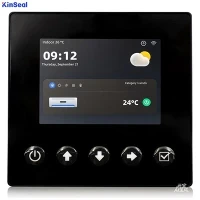


Industrial control equipment is an indispensable part of modern industrial production. Through automation and intelligent control, it improves production efficiency, reduces production costs, and ensures product quality. This article will provide a detailed overview of the types, functions, and applications of industrial control equipment.
I. Classification of Industrial Control Equipment
1. Programmable Logic Controllers (PLCs)
Programmable Logic Controllers are control devices widely used in the field of industrial automation. They control production processes through programming and are characterized by high reliability, good flexibility, and ease of maintenance.
2. Human-Machine Interface (HMI)
A Human-Machine Interface is a device used to display and control production processes, typically used in conjunction with a PLC. It features an intuitive user interface that facilitates the monitoring and control of production processes.
3. Servo System
A servo system is a high-precision, high-response-speed control system widely used in fields such as machining and robotics. By precisely controlling motors, it enables precise control of production processes.
4. Motion Controller
A motion controller is a device used to control mechanical motion; it can control the synchronized movement of multiple axes to achieve complex motion path control.
5. Sensors
Sensors are devices used to detect various parameters in the production process, such as temperature, pressure, and flow rate. They convert the detected signals into electrical signals, providing input to the control system.
6. Actuators
Actuators are devices used to implement production process control, such as cylinders and motors. They convert commands from the control system into mechanical motion, thereby controlling the production process.
7. Industrial Computers
Industrial computers are computers specifically designed for industrial control, featuring high reliability and stability. They serve as the central hub of the control system, enabling control over the entire production process.
8. Industrial Networks
Industrial networks are network systems used to facilitate communication between devices, such as Ethernet and fieldbus. They enable data exchange between devices, enhancing coordination within the production process.
II. Functions of Industrial Control Equipment
1. Enabling Automated Control
Industrial control equipment enables automated control of production processes, reducing manual intervention and improving production efficiency.
2. Enabling Precise Control
Through high-precision sensors and actuators, industrial control equipment enables precise control of production processes, ensuring product quality.
3. Enabling Remote Monitoring
Through industrial networks, industrial control equipment enables remote monitoring of production processes, allowing managers to monitor and adjust operations conveniently.
4. Enabling Data Collection and Analysis
Industrial control equipment collects various data during production-such as temperature, pressure, and flow rate-and uses data analysis to provide a basis for optimizing production processes.
5. Fault Diagnosis and Alarms
Industrial control equipment can monitor anomalies in the production process in real time and issue timely alarms to prevent production accidents.
6. Energy Management
Through energy management systems, industrial control equipment can ensure the rational allocation and use of energy during the production process, reducing energy consumption and achieving energy conservation and emissions reduction.
III. Applications of Industrial Control Equipment
1. Machinery Manufacturing
In the field of machinery manufacturing, industrial control equipment can control machine tools, robots, and other equipment, thereby improving production efficiency and product quality.
2. Chemical Industry
In the chemical industry, industrial control equipment can control reactors, pumps, valves, and other equipment, ensuring the stability and safety of production processes.
3. Power Industry
In the power industry, industrial control equipment controls equipment such as generators and transformers, ensuring the stable operation of the power system.
4. Metallurgical Industry
In the metallurgical industry, industrial control equipment controls equipment such as smelting furnaces and rolling mills, improving production efficiency and product quality.
5. Food Processing
In the food processing industry, industrial control equipment controls production lines to ensure food quality and safety.
6. Packaging Industry
In the packaging industry, industrial control equipment controls packaging machines, sealing machines, and other equipment to improve packaging efficiency and quality.
7. Logistics Industry
In the logistics industry, industrial control equipment controls conveyor belts, stackers, and other equipment to improve logistics efficiency.
IV. Development Trends in Industrial Control Equipment
1. Intelligence
With the advancement of artificial intelligence technology, industrial control equipment will become more intelligent, enabling adaptive control of production processes.
2. Networking
Industrial control equipment will place greater emphasis on networking, enabling interconnectivity among devices and enhancing coordination in production processes.
3. Integration
Industrial control equipment will place greater emphasis on integration, combining multiple functions into a single device to simplify the complexity of control systems.
4. Environmental Sustainability
Industrial control equipment will place greater emphasis on environmental sustainability, promoting the rational use of energy during production processes, reducing energy consumption, and achieving energy conservation and emissions reduction.
5. Customization
As market demands diversify, industrial control equipment will place greater emphasis on customization to meet the needs of different industries and enterprises.
In summary, industrial control equipment plays a vital role in modern industrial production. Through automation and intelligent technologies, it improves production efficiency, reduces production costs, and ensures product quality. With the continuous advancement of technology, industrial control equipment will become increasingly intelligent, networked, integrated, eco-friendly, and customized, opening up new possibilities for industrial production.