




PLCs, which stands for Programmable Logic Controllers, are industrial-scale devices with computing power used to control production processes in assembly lines, robotic cells, industrial machinery, and other manufacturing environments. They are used for processes such as fault detection, high reliability, and programmable manufacturing control.PLCs operate in real time because their inputs must be processed in a very short period of time. The timeliness of their operation has always been critical to the success of their control purpose. The primary motivation for introducing PLCs decades ago was to replace hard-coded relay systems with more flexible programmable controllers.
PLCs do not look like traditional computers because they are ruggedized for wear and vibration resistance. there are many types of PLCs, with varying numbers and types of I/O (inputs/outputs), housings and packages, and the ability to interact with other PLCs and SCADA systems. these characteristics of PLCs determine their ability to operate in harsh industrial environments in a manner that is resistant to heat and vibration, while being unaffected by electrical noise. These characteristics of PLCs allow them to operate in harsh industrial environments in a manner that is resistant to high temperatures and vibration, while being immune to electrical noise.
The most common function of a PLC controller is similar to an electromechanical relay. Specifically, a PLC receives a set of discrete inputs and audits the state of the inputs to see if they are open or closed. This operation is based on a "scan cycle" that reads the PLC inputs, executes the programmable logic, and writes its outputs. These three steps are repeated over and over within the PLC's operating envelope as the scan cycle is repeated.
The PLC program performs a logical "AND" function on a series of inputs. When all input bits are open, current is allowed to pass. Similarly, they perform a logical "or" function on a set of inputs provided in parallel. In this case, current is allowed to pass if at least one input is open. In implementing these functions, the PLC applies a specific order in the evaluation of the logic functions. It is strictly left-to-right and top-to-bottom execution, in contrast to the less strict operation of conventional relaying. There are also PLCs that implement more complex functions (e.g., internal discrete logic functions) to produce outputs indicating completion or some error.
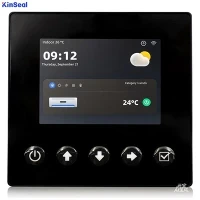
End-users (e.g., automation engineers) interact with PLCs to configure them, but also to receive alarms and notifications. For this purpose, the PLC provides a human-machine interface (HMI), including a graphical user interface (GUI). Common HMI controls include buttons, indicators, text displays, and touch screens. In complex installations, PLCs can be connected to a personal computer to provide a more sophisticated and ergonomic user interface.