




In the fields of industrial automation and the Internet of Things (IoT), the Modbus communication protocol (often referred to as the MC protocol) remains a key standard to this day as one of the oldest open communication standards. This article provides an in-depth analysis of the Modbus protocol from four perspectives-technical principles, protocol variants, application scenarios, and security challenges-and explores its future direction in the context of modern industrial environments.
I. Protocol Architecture and Technical Principles
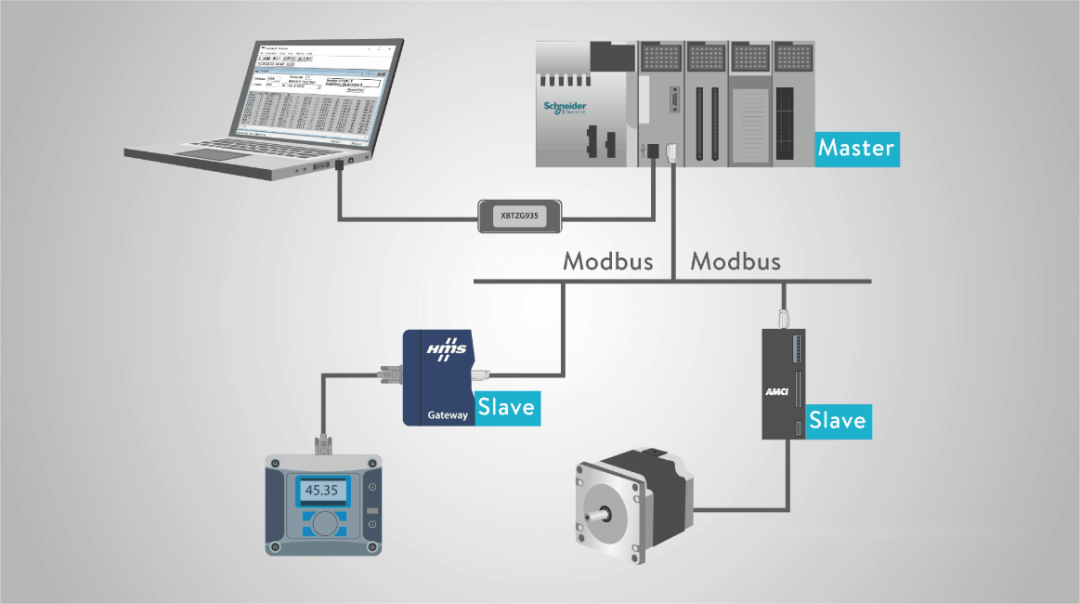
Modbus was developed in 1979 and is based on a master-slave architecture. The physical layer was originally based on RS-232/RS-485 serial communication and was later expanded to support TCP/IP networks. A Protocol Data Unit (PDU) consists of a function code and a data field, where the function code is divided into common codes (1–127) and user-defined codes (128–255). Typical operations include:
● Function codes 01/02: Read coils/discrete inputs.
● Function codes 03/04: Read hold/input registers.
● Function codes 05/06: Write a single coil/register.
● Function code 16: Bulk write to registers.
The data model employs four address spaces: Coils (00001–09999), Discrete Inputs (10001–19999), Input Registers (30001–39999), and Hold Registers (40001–49999). This design cleverly balances device compatibility and scalability; for example, when a PLC reads address 40001 using function code 03, it actually accesses the device's first hold register.
II. Protocol Variants and Evolutionary Path
1. Serial Version (RTU/ASCII)
RTU mode uses binary encoding and CRC checksumming, offering higher transmission efficiency than ASCII mode. A typical frame structure includes an address field (1 byte), function code (1 byte), data field (N bytes), and checksum field (2 bytes). The baud rate is typically set to 9600 bps or 19200 bps, with a 3.5-character interval serving as the frame delimiter.
2. TCP/IP Adaptation
Modbus/TCP converts the unit identifier into an MBAP header while retaining the original PDU structure. TCP port 502 is the standard convention, and a single message can carry up to 253 bytes of payload data. In modern implementations, the throughput of the TCP version can exceed that of RTU by more than 10 times; however, the impact of network latency on real-time performance must be considered.
3. Extended Protocol Family
● Modbus Plus (MB+) uses a token ring architecture and supports peer-to-peer communication.
● Modbus Secure adds a TLS encryption layer.
● Modbus UDP is suitable for broadcast scenarios.
III. Analysis of Typical Application Scenarios
1. Industrial Control Systems
In SCADA systems, Modbus often serves as a communication bridge between PLCs and HMIs. A case study of an automotive production line demonstrates that by connecting over 200 sensors via Modbus TCP, the sampling cycle can be reduced to 50 ms, meeting the synchronized control requirements of stamping machines.
2. Energy Management Systems
Smart meters commonly use Modbus RTU to transmit electricity consumption data. A monitoring system at a photovoltaic power plant uses function code 03 to poll inverters, collecting data from 32 registers-including power generation and voltage-every 5 minutes, processing over 200,000 messages daily on average.
3. Building Automation
HVAC equipment integrates temperature and humidity sensors via Modbus. A project at a commercial complex in Beijing demonstrated that a multi-threaded polling strategy can keep the data update cycle for 200 VAV units within 10 seconds.
IV. Security Challenges and Mitigation Strategies
1. Inherent Vulnerabilities
● Lack of Authentication: Any host can send control commands.
● Plaintext Transmission: Wireshark can directly parse message contents.
● Function Code Abuse: Function code 05 may trigger device malfunctions.
2. Typical Attack Patterns
● Man-in-the-middle attacks: Tampering with register values causes PLC malfunctions.
● Denial-of-service attacks: Blocking communication via high-frequency queries.
● Function code probing: Obtaining device fingerprints.
3. Protective Measures
● Network Layer: VLAN segmentation + port isolation.
● Protocol Layer: Deploying Modbus Secure gateways.
● Application Layer: Whitelist filtering of abnormal function codes.
● Management Measures: Regularly update the slave address mapping table.
V. Future Development Trends
1. OPC UA Integration
Emerging gateway devices support semantic conversion from Modbus to OPC UA, addressing the deficiency of traditional protocols in lacking metadata descriptions. A certain oil pipeline project adopted this solution, enabling data from legacy RTU devices to be directly integrated into the Industrial Internet of Things (IIoT) platform.
2. Time-Sensitive Networking (TSN) Adaptation
Under the IEEE 802.1Qbv standard, Modbus TSN enables microsecond-level time synchronization, meeting the demands of high-precision motion control. Laboratory tests show that Time-Aware Shaping (TAS) can reduce control command jitter to ±15 μs.
3. Edge Computing Enhancements
Deploying a Modbus data preprocessing module on the gateway side can reduce uplink traffic by 70%. A wind turbine predictive maintenance system performs FFT analysis via edge nodes, uploading only feature values rather than raw vibration data.
From a technical perspective, Modbus's success stems from its philosophy of "simplicity taken to the extreme." Despite numerous limitations, through continuous evolution and ecosystem enhancements, this protocol-born in the 1970s-continues to thrive amid the wave of smart manufacturing. Over the next five years, as the Industrial Internet deepens, Modbus may transition into the exclusive role of a "connector for legacy devices," continuing to play an irreplaceable role in specific sectors.