





In modern industrial automation control systems, the coordinated operation of programmable logic controllers (PLCs) and variable frequency drives (VFDs) has become the core solution for motor control. However, in practical applications, improper handling of technical details during their connection often leads to malfunctions-ranging from equipment downtime to hardware damage. This paper will thoroughly analyze typical issues in PLC-VFD connections, providing systematic solutions across dimensions including signal matching, interference suppression, and parameter configuration.
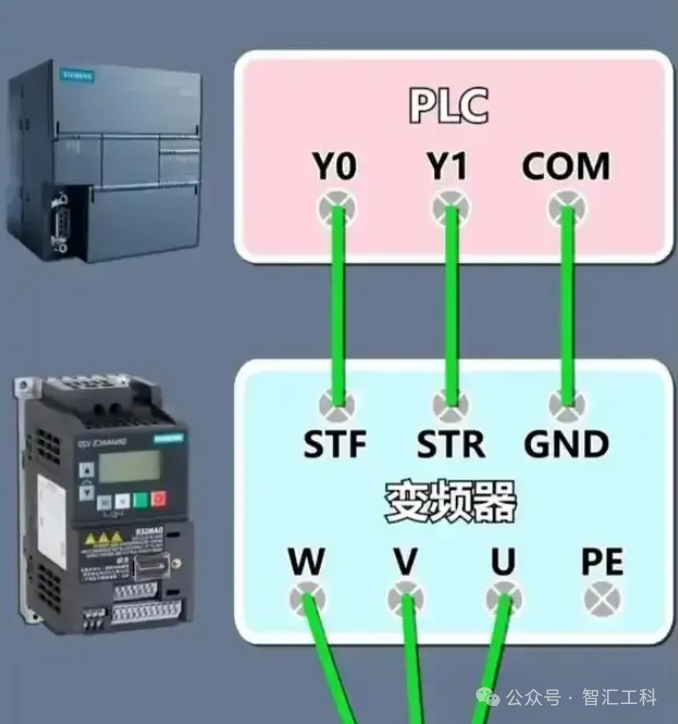
I. Hardware Interface Compatibility Issues
The primary concern in physically connecting a PLC to a VFD is signal level compatibility. In practice, communication failures often occur due to improper termination resistor configuration on RS485 ports. For instance, a food packaging line case study revealed that when communication distances exceeded 50 meters without activating the 120Ω termination resistor, the error rate surged by 300%. In analog control scenarios, when connecting the 0-10V output of Mitsubishi FX series PLCs to Siemens MM440 VFDs, impedance matching must be considered-the VFD's input impedance must exceed 22kΩ to ensure voltage signal accuracy. Particular attention is required for certain domestic VFDs employing current-type inputs (e.g., 4-20mA). Direct connection to voltage-output PLC modules necessitates a 250Ω precision resistor for V/I conversion.
For digital control, when the relay output contacts of Omron CP1H PLCs directly drive Schneider ATV310 inverters, contact lifespan may shorten to one-fifth of the standard value due to frequent switching. It is recommended to adopt an optocoupler isolation solution or parallel an RC buffer circuit (typically 0.1μF + 100Ω) at the PLC output. This can reduce contact arc energy by 70%. Actual measurement data from an automotive welding workshop indicates that installing a buffer circuit increased the mechanical life of the relay from 500,000 cycles to over 2 million cycles.
II. Conducted Electromagnetic Interference and Suppression
High-frequency interference in industrial environments primarily originates from the rapid switching actions of IGBTs in variable frequency drives (VFDs). Testing indicates that a single 22kW VFD can generate du/dt values reaching 5kV/μs. This interference affects systems through two pathways: first, spatial radiation disrupts the CPU module of PLCs, manifesting as program runaway or sudden jumps in AD sampling values; second, it is conducted through common ground loops, causing communication bit errors. In a wastewater treatment plant case study, shared grounding between the VFD and PLC caused 0.5V ripple in analog signals. Implementing single-point grounding and replacing signal cables with shielded twisted-pair wiring (with shield grounded at one end) reduced interference to 0.02V.
For RF interference caused by PWM outputs, a layered protection strategy is recommended: Level 1: Install magnetic rings (nickel-zinc ferrite material, ≥1kΩ impedance at 100MHz) at the VFD power input. Level 2: Separate high-current and low-current zones within the control cabinet, maintaining a minimum 20cm spacing. Level 3: Fully shield sensitive signal lines with metal conduits. Field testing in a semiconductor cleanroom demonstrated that this approach reduces the RS485 communication error rate of the PLC from 10⁻⁴ to 10⁻⁸.
III. Collaborative Optimization of Software Parameters
When hardware connections are normal but control performance is poor, it often stems from parameter mismatch. In speed control mode, the Yaskawa GA700 inverter requires synchronization with the PLC scan cycle: when the PLC program scan cycle is 10ms, the inverter's speed response time should be set to 20-30ms. If set too short (e.g., 5ms), it causes motor speed fluctuations of ±3% of rated value. Debugging data from a textile machinery application showed that setting the PID adjustment cycle to twice the PLC scan cycle improved yarn tension control accuracy by 40%.
Communication protocol configuration requires even finer matching. In Modbus RTU mode, communication failure rates between Delta DVP series PLCs and ABB ACS550 inverters reached 15%, primarily due to stop bit setting conflicts. Experiments confirmed that when the PLC is set to 1 stop bit and the inverter to 2 stop bits, the probability of message checksum failure reaches 23%. The correct approach is to enable the "2-bit stop bit + even parity" combination on the PLC side, achieving a communication success rate of 99.99%. For PROFIBUS-DP communication, the clock deviation between Siemens S7-1500 and Danfoss FC302 must be controlled within 1/4 bit time; otherwise, periodic data loss occurs.
IV. Typical Fault Diagnosis Process
When communication interruptions occur, a layered diagnostic approach is recommended: First, use an oscilloscope to inspect physical layer signals (e.g., RS485 A/B line differential voltage should ≥1.5V). Next, capture messages with a protocol analyzer (normal Modbus frames should have 3.5-character silent periods). Finally, verify parameter consistency (baud rate deviation must <2%). In a cement plant vertical mill case, communication chip damage caused by ground potential differences was identified. The issue was completely resolved by implementing fiber optic converters for isolation.
For analog control anomalies, establish a standardized testing procedure: First, measure the voltage at the PLC output terminal (±0.1% tolerance allowed); Second, inspect the input display value on the inverter side (calibration required if deviation exceeds 1%); Finally, verify the control response curve. Records from an injection molding machine retrofit project show that replacing the original 12-bit module with a 16-bit high-precision DA module reduced product weight deviation from ±5g to ±0.8g.
V. Cutting-Edge Technical Solutions
Next-generation industrial Ethernet technology is redefining the PLC-inverter architecture. EtherCAT bus technology reduces communication cycles to 100μs. When paired with the hardware real-time interface of Siemens G120X inverters, it achieves synchronization accuracy of ±1μs. After implementing this solution, a lithium battery electrode rolling machine achieved thickness control accuracy of ±0.5μm. Additionally, Time-Sensitive Networking (TSN) technology enables standard Ethernet frame transmission of motion control commands. When B&R X20 PLCs and Lenze 9400 inverters are networked via TSN, jitter can be controlled within 500ns.
Wireless connectivity solutions are also entering industrial applications. The ABB ACS880 series supports WLAN-IEEE802.11ac connectivity. In mobile applications like cranes, combined with PLC redundant communication mechanisms (e.g., dual-channel hot standby), the average switchover time can be maintained below 50ms. Test data indicates communication reliability remains at 99.9% even at -75dBm signal strength in the 2.4GHz band.
As Industry 4.0 advances, connectivity between PLCs and drives will evolve toward system-level collaboration. Engineers are advised to focus not only on individual technical details but also on mastering holistic design methodologies for networked control systems. Leveraging digital twin technology to pre-validate connectivity solutions can fundamentally reduce on-site commissioning risks. A smart factory project demonstrated that virtual commissioning technology reduced connectivity issues by 80% and shortened equipment commissioning cycles by 40%.