


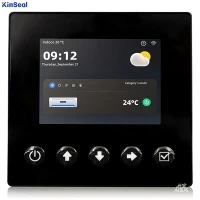


HMI as a high-tech products, has begun to gradually enter the public's life. In fact, human-computer communication is no stranger, HMI is a human-computer communication equipment.
HMI is the abbreviation of human-machine interface. We use HMI in industry to control and monitor equipment. A common HMI that you will often come across is the ATM machine. Screens and buttons allow you to operate the machine to accomplish withdrawals or deposits.
There are three basic types of HMIs: button changers, data handlers, and supervisors.
Button Changers
Before the advent of HMIs, a single control could consist of hundreds of buttons and LEDs that performed different actions. Button Replacement HMIs simplify the manufacturing process by centralizing all the functions of each button in one location. Pushbutton replacements replace LEDs, on/off buttons, switches, or any mechanical device that performs a control function. Eliminating these mechanical devices is possible because the HMI provides a visual representation of all of them on its LCD screen while performing all of the same functions.
Data Handling Programs
Data handling programs are ideal for applications that require continuous feedback from the system or printouts of production reports. For data processors, you must ensure that the HMI screen is large enough to display information such as graphs, visual representations of data, and production summaries. Data processors include functions such as recipes, data trending, data logging, and alarm handling/logging. Data processors are used in applications that require continuous feedback and monitoring. These data processors are usually equipped with mass storage.
Supervisor
Supervisory HMIs are useful whenever an application involves SCADA or MES. Supervisory HMIs will most likely require Windows to run and have multiple Ethernet ports. Supervisors work with SCADA and MES. These are centralized systems used to monitor and control entire sites or complexes of large systems distributed over a large area.HMIs are often linked to the SCADA system's database and software programs to provide trending, diagnostic data, and management information.
The basic types of human-machine interface (HMI) mainly include the following:
1. touch screen (Touch Screen): touch screen is a capacitive, resistive, surface acoustic wave, infrared and visual and other technologies as the core of the device, which will be the display and touch pad integrated together, with a finger or pointer touch, scratch, slide and other operations to achieve control and interaction.
2. Push-button (Keypad): Push-button human-machine interface is the use of physical buttons to achieve control and interaction, it is usually simple, reliable, easy to operate and other characteristics, applicable to certain industrial control, security systems, access control and other fields.
3. Mouse (Mouse): Mouse-type human-machine interface is often used with a computer or other equipment, the screen through the mouse's movement, single or dual-machine and other ways to operate and control, applicable to general office, entertainment, education and other fields.
4. Voice Recognition (Voice Recognition): Voice Recognition is to convert voice signals into digital signals of the computer, through the human voice to interact with the computer and control, applicable to the hand is not sensitive or the environment is not convenient for the operation of the occasion.
5. Gesture Interaction (Gesture Control): Gesture interaction is the use of human hand posture, movement and motion characteristics to achieve human-computer interaction, which is usually applied to virtual reality, games and entertainment, video conferencing and other fields.
6. Holographic Projection: Holographic projection is to present the image of 3D model in space, and realize control and interaction through hand movements, voice and other ways, which is usually applicable to virtual reality, technology display, art display and other fields.
The above is the basic types of human-machine interface (HMI), different types of human-machine interface in different fields and occasions each has its own advantages and disadvantages, according to the user's needs and the specific circumstances of the selection of the right type of HMI equipment is very important.