


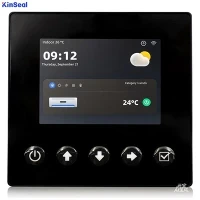


In industrial applications, mechanical buttons on sensor nodes, industrial instruments and control panels are prone to dust, and the more dust that accumulates, the more it eventually leads to equipment failure. Human Machine Interface (HMI) systems that replace mechanical buttons with capacitive touch mechanisms in industrial environments offer advantages such as sleeker design, ease of cleaning and less susceptibility to mechanical failure. The latest capacitive touch technology is a step forward in solving some of the toughest challenges in industrial HMIs.
Immunity Challenges
Motors, repeaters, and switches operating in industrial environments can inject significant noise into power lines. These noise sources can falsely trigger a device when a fluctuation in the measurement signal intersects the detection threshold. The image below shows how capacitance measurements are affected when noise is present.

With the help of multi-frequency scanning and processing, spread spectrum modulation, and zero-crossing detection built into the hardware, buttons that support capacitive techniques will overcome the effects of noise in the system. The picture below shows the interference signal processed with the above mentioned techniques.

Thick Protective Covers and Glove Issues
To protect electronic components from hazardous and unclean environments, industrial panels often have a thick glass or plastic protective cover. Without drilling holes in the protective cover, it is often impossible to mount mechanical buttons where they are needed, and this makes the panel prone to failure. Industrial environments also often require gloves to be worn for machine operation. While this is not a major issue for mechanical buttons, it can have a huge impact on capacitive touch solutions.
Capacitive pushbuttons can operate through 60mm thick glass and 25mm thick plastic shields, which allows them to be used in sterile as well as hazardous environments while keeping the shield material intact.
Capacitance buttons rely on a change in capacitance value to understand a command, and detection is triggered when a grounded object - a human hand - comes into the electric field of the touch sensor. Wearing industrial gloves adds a layer of insulating material (dielectric) between the hand and the electrode, resulting in unreliable detection.
By using a metal protective cover, it is possible to operate the capacitive touch screen while wearing gloves. Instead of measuring the change in capacitance caused by the hand entering the electric field, it measures the change in capacitance caused by the deformation and bending of the grounded metal shield. This makes this technology support glove-friendly design.

Low Power Operation Challenges
Several field emitters in industrial systems are powered by a current loop, which provides a very limited power budget. While maintaining the ability to detect up to four buttons with less than 4uA of power consumption, the capacitor-based technology provides industrial users with the ability to set and monitor field devices with very low power overhead.
The Solution
Developing with MSP430™ microcontroller (MCU) CapTIvate™ technology helped avoid many of the challenges. the CaTIvate touch MCU not only provides a compact and easy solution to replace mechanical buttons in industrial HMI systems, it also solves many of the problems with existing capacitive touch solutions, such as robustness and durability in noisy environments. the IEC certified solution makes it supportable for wearable devices. certified solution makes it glove-friendly and low-power.