


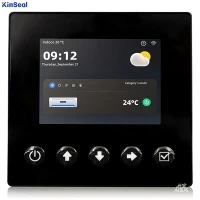


Industrial control computers are computer systems specifically designed for use in industrial environments, where they play a key role in automating, monitoring and controlling industrial production processes. Due to the special characteristics of industrial environments, industrial control computers have some unique features and requirements.
1. Environmental adaptability
Temperature resistance: industrial control computers need to operate stably in high and low temperature environments, usually required in the range of -20 ℃ to 70 ℃ normal operation.
Dust and waterproof: Industrial environments have more dust and moisture, so they need to have IP-rated dust and waterproof capabilities.
Anti-vibration: Industrial equipment may generate vibration during operation, the computer needs to have good anti-vibration performance.
2. Reliability
High stability: industrial control computers need to run stably for a long time, and are not prone to failure.
Redundant design: Key components such as power supply, storage, etc. may be redundant design to improve system reliability.
Failure diagnosis:With self-detection and failure diagnosis function, it can detect and report problems in time.
3. Real-time
Real-time operating system: the use of real-time operating system, to ensure timely response and execution of tasks.
Low latency: In the data acquisition, processing and execution of control commands, very low latency is required.
4. scalability
Modular design: Easy to expand and upgrade according to different application requirements.
Rich interfaces: Provide a variety of interfaces, such as serial port, USB, Ethernet, etc., to adapt to different peripheral connection requirements.
5. Security
Data security: with data encryption and secure storage to prevent data leakage.
Network security: with firewall and intrusion detection system to protect the system from network attacks.
6. User Interface
Graphical interface: Provides an intuitive graphical user interface for easy operation and monitoring.
Multi-language support: Support multiple languages to meet the needs of different regions.
7. Software Support
Programming environment: Provide rich programming tools and libraries to support multiple programming languages.
Compatibility: Compatible with a variety of industrial software and protocols.
8. Energy consumption management
Energy-saving design: Optimize energy consumption and reduce operation cost under the premise of guaranteeing performance.
Power management: With power management function, it can reduce power consumption at low load.
9. Remote Maintenance
Remote Access: Supports remote access and control for maintenance and troubleshooting.
Remote Upgrade: Supports remote software upgrade, reducing on-site maintenance costs.
10. Standardization
Compliance with standards: Compliance with international standards in the field of industrial automation to ensure compatibility with other systems.
Application Scenario Analysis
Industrial control computers are widely used in a variety of industrial automation fields, such as manufacturing, electric power, petrochemical, rail transportation and so on. The following is an analysis of some specific application scenarios:
- Manufacturing industry: In production lines, industrial control computers are used to control the operation of machines and realize automated production.
- Power industry: In substations and power plants, they are used to monitor and control the operation status of power equipment.
- Petrochemical industry: In the petroleum and chemical production process, it is used to monitor and adjust the production parameters in real time.
- Rail transportation: In subway and high-speed railway systems, it is used for monitoring and scheduling of train operation.
Technology Development Trends
With the development of technology, industrial control computers are also advancing, the following are some of the main trends:
- Integration : Integrate more functions and interfaces to reduce the dependence on external devices.
- Intelligent : Introducing artificial intelligence technology to improve the system's adaptive ability and decision-making ability.
- Cloud Computing: Utilizing cloud computing technology to achieve centralized data storage and processing, and improve data processing capabilities.
- Internet of Things (IoT) : Combine with IoT technology to realize remote monitoring and control of equipment.
Conclusion
Industrial control computers play a vital role in modern industrial production. They need to be highly environmentally adaptable, reliable, real-time, scalable, secure, easy to use, software support, energy management, remote maintenance, and standardized.