


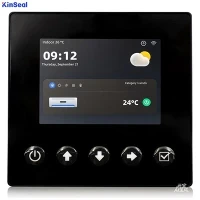


The Distribution Automation Terminal (DAT) serves as the execution unit of the distribution automation system and is a critical component of the system. It primarily monitors and controls switching equipment within the distribution system and provides functions such as fault location and isolation, as well as system protection.
Distribution automation terminals are typically classified into three types: Feeder Terminal Units (FTUs), Distribution Substation Terminal Units (DTUs), and Transformer Terminal Units (TTUs). Depending on the application scenario, FTUs are generally mounted on utility poles to collect switching status information from circuit breakers, load switches, and other devices. This status data is transmitted in real time to the master station via wireless transceiver modules. In the event of a fault, the FTU also controls the connected distribution equipment based on commands issued by the master station.
During installation, a single FTU is typically used to monitor a single pole-mounted switch. When two lines are mounted on the same pole, to reduce costs, two FTUs can be cascaded to form a master-slave configuration, where the master FTU communicates directly with the master station, while the slave FTU communicates with the master station indirectly via the master FTU.
Based on application scenarios, the distribution terminals currently used in the field of distribution automation primarily fall into the following categories:
(1) Feeder Terminal Unit (FTU): A distribution terminal installed on utility poles or similar locations along distribution network feeder circuits, equipped with remote signaling, remote measurement, and remote control functions;
(2) Distribution Terminal Unit (DTU): A distribution terminal installed in switch stations, distribution rooms, ring main units, or containerized substations within distribution network feeder circuits, equipped with remote signaling, remote measurement, and remote control functions;
(3) Transformer Terminal Unit (TTU): A distribution terminal used for monitoring and measuring various operational parameters of distribution transformers.
Depending on their functions and scope of application, distribution automation terminals can be classified into the following types:
1. Power Monitoring Terminals: Primarily responsible for collecting data from various power equipment in the distribution system, enabling real-time monitoring and collection of information regarding operational status, power consumption, load, and faults, thereby ensuring the safe and stable operation of the distribution network.
2. Control Terminals: Primarily responsible for the remote operation and control of various power equipment within the distribution system, thereby optimizing and improving the operational management and business processes of the distribution system.
3. Communication Terminals: These are primarily responsible for facilitating information exchange between various terminal devices, enabling data transmission and communication among them, and thereby ensuring more stable and automated operation and management of the power distribution system.
4. Display Terminals: These are primarily responsible for displaying and analyzing data and information from the power distribution system. They process collected data into corresponding information displayed on screens for personnel to view and analyze, enabling real-time monitoring of power equipment and early warning of various system anomalies.
5. Integrated Terminals: These terminals combine the functions of the aforementioned terminal types and possess comprehensive power distribution automation control capabilities, making them the most critical category of terminals in the power distribution system. Through their own logic control capabilities, these terminals exchange data with computer networks to achieve intelligent operation management and monitoring control.
6. Customer Terminal: Primarily provides services to industrial and commercial customers, including real-time energy consumption monitoring, electricity usage forecasting, and recommendations for efficient power usage. Through the customer terminal, users can conveniently access information on the power consumption of electrical equipment, thereby achieving energy savings and cost reduction.
In summary, power distribution automation terminals can be classified into various types based on their functions and scope of application, including power monitoring terminals, control terminals, communication terminals, display terminals, integrated terminals, and customer terminals.