





Modbus TCP
Modbus TCP is an industrial communication protocol based on the TCP/IP protocol, designed for communication over Ethernet networks. This protocol features the following characteristics:
1. Network Communication: Modbus TCP is suitable for network communication environments, enabling data transmission and control between devices on local area networks (LANs). Devices are connected via standard Ethernet cabling to achieve real-time monitoring between them.
2. Flexibility and Reliability: Built upon the TCP/IP protocol, Modbus TCP offers high flexibility and reliability. It operates effectively in complex network topologies and supports communication among large-scale machinery.
3. Real-Time Monitoring and Control: Ideal for applications requiring real-time monitoring and control in industrial automation, such as remote device management and data transmission. Using Modbus TCP, engineers can monitor system status and perform operations from remote locations.
Modbus RTU
Modbus RTU is an industrial communication protocol based on serial communication, typically utilizing physical connections via serial ports like RS-485 or RS-232. Its functions include:
1. Serial Communication: Modbus RTU operates in serial communication environments, facilitating data transfer and control between field devices. It is commonly used in industrial settings to monitor the operational status of control equipment or machinery.
2. Transmission Rate: Utilizing serial communication methods, Modbus RTU achieves high transmission rates, making it suitable for scenarios demanding rapid communication. This advantage positions it well for synchronous control and monitoring applications.
3. Stability and Interference Resistance: In industrial field environments, Modbus RTU communication demonstrates excellent stability and adapts well to remote communication and noise interference. This provides it with strong interference resistance in industrial settings.
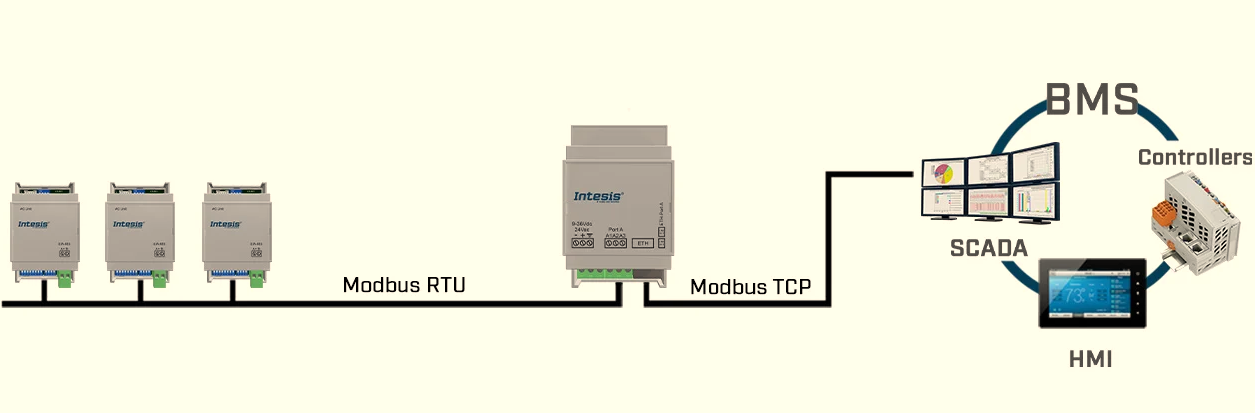
Modbus TCP and Modbus RTU
Differences and Primary Applications
1. Communication Method: Modbus TCP operates based on the TCP/IP protocol, utilizing TCP for network communication; Modbus RTU relies on serial port communication, suitable for field device serial interfaces.
2. Data Frame Structure: Modbus TCP features a more complex data frame structure requiring TCP/IP protocol stack processing, while Modbus RTU employs a compact data frame structure suitable for resource-constrained devices.
3. Primary Applications: Modbus TCP is suitable for scenarios requiring network communication, such as real-time monitoring and remote device management.
Application Scope, Features, and Characteristics of Modbus TCP
1. Industrial Automation Technology: Modbus TCP is widely used in industrial automation fields such as production line operations, warehouse management, and equipment monitoring. Its advantages include enabling real-time monitoring, timely data transmission, and remote device operation.
2. Building Automation: Within building management systems, Modbus TCP is commonly employed to control lighting, HVAC, security systems, and other internal equipment for information-based management.
3. Energy Management: Within energy monitoring and management systems, Modbus TCP is suitable for real-time monitoring of energy consumption and equipment operational status, enhancing energy utilization efficiency.
Application Scope, Features, and Characteristics of Modbus RTU
1. Industrial Field Control: Modbus RTU is typically used for field device control and monitoring, such as controlling motors, sensors, and actuators. Due to its high transmission rate and reliability, it is widely employed in industrial control environments.
2. Environmental Monitoring: Within environmental monitoring systems, Modbus RTU collects data on gases, temperature, humidity, and other parameters, transmitting this information to monitoring systems for analysis and processing.
3. Data Acquisition: In data management systems, Modbus RTU connects to various field devices for data collection, storage, and transmission, enabling data analysis and oversight.
Industry Development Prospects
1. IoT Integration: With the advancement of IoT technology, the Modbus protocol is expanding into the IoT domain, integrating with other communication protocols to enable information sharing between devices.
2. Enhanced Security: As cybersecurity awareness grows, future Modbus protocols will prioritize communication security by strengthening encryption and authentication systems for transmitted data.
3. Diversified Applications: Responding to evolving industry demands, Modbus protocols will expand into new domains such as smart cities, agricultural IoT, and healthcare services.
Overall, Modbus TCP and Modbus RTU possess distinct application scopes and advantages, playing vital roles in industrial and automation sectors. As technology advances and application requirements shift, these protocols will continue to evolve and improve, delivering reliable communication and operational solutions across diverse scenarios.