




The application of CAN is getting wider and wider, CAN bus can be found everywhere, such as automotive electronics, industrial control, and large-scale instrumentation.
1986: CAN bus was introduced;
2012: CAN FD was introduced;
2020: the new generation of CAN XL was introduced;
The first generation of CAN
CAN: Controller Area Network, i.e. Controller Area Network, belongs to the industrial field bus, which is an ISO international standardized serial communication protocol.
CAN bus is one of the most widely used field buses internationally, and has now become the standard bus for automotive computer control systems and embedded industrial control LANs.
From the perspective of OSI (Open System Interconnection) 7-layer network model, CAN fieldbus only defines layer 1 (physical layer) and layer 2 (data link layer).
I have written a lot about CAN and CANOpen before, you can search for it on the homepage of my public number or reply to "CAN" in the background to see more content.
Second Generation CAN
CAN FD: CAN with Flexible Data-Rate, translated as CAN with Variable Rate.
It is an upgraded version of the classic CAN by increasing the transmission rate, and the data field can be transmitted up to 64 bytes, which is the function of variable speed.
CAN FD uses two ways to improve the efficiency of communication:
Shorten the bit time to increase the bit rate;
Lengthening the data field length to reduce the number of messages to lower the bus load rate.
Three types of polynomials are used in the CRC checksum section to ensure data reliability in high-speed communication.
Difference between the first generation and the second generation CAN
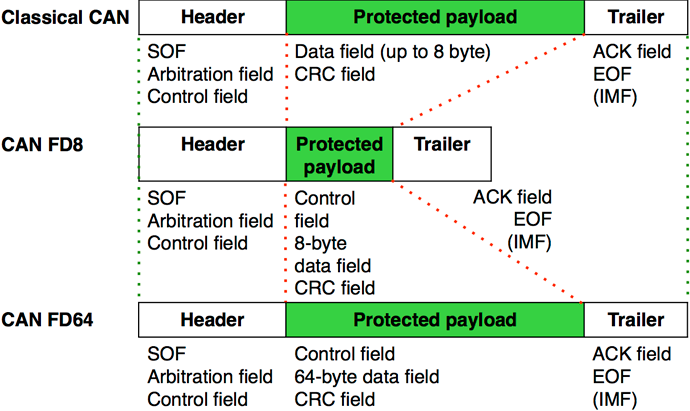
1. Different number of data bits
CAN: Maximum 8 bytes of data in one frame.
CAN FD: Maximum 64 bytes of data in one frame.
2. Different speeds
CAN: Maximum 1Mbit/s
CAN FD: greater than 1Mbit/s
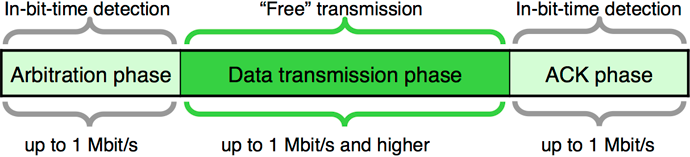
Of course, in addition to the difference in data bits, there are also differences in variable rates, frame formats, and so on.
Third Generation CAN
After CAN and CACN FD, in January 2020, CiA officially launched a new generation of CAN XL.
CAN XL will provide a data field of up to 2048 bytes. The network layer can use the 11-bit priority field for addressing purposes and indicate the contents of the data field.
CAN XL frames are protected by two CRCs (Cyclic Redundancy Checks), which detect five randomly distributed error codes.
CAN XL is a highly scalable communication technology involving bit rates and data field lengths. The physical layer is still under development. The goal is to reach bit rates of up to 10+ Mbit/s.

CAN XL is optimized for regionally oriented heterogeneous network architectures, a solution that meets future requirements for optimizing the length of in-vehicle networks and reducing cabling.