


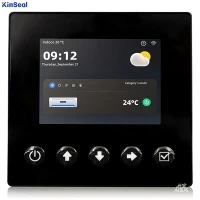


The Industrial Internet of Things (IIoT) is defined as a set of devices and applications that allow large organizations to create an end-to-end connected environment from the core to the edge. It also includes traditional physical infrastructure, such as containers and logistics trucks, to collect data, react to events, and make more informed decisions with the help of smart devices.
The Industrial Internet of Things (IIoT) is an extension of the Internet of Things (IoT) and has many applications in the consumer space. IoT use cases include, for example, smart home devices such as Amazon Echo, which use Alexa voice recognition to turn off lights remotely.
In industrial operations, the technology has seen large-scale commercial adoption in environments with complex infrastructure and large equipment. In contrast, industrial IoT can remotely manage heating, ventilation and air conditioning (HVAC) systems throughout a plant. This is just one industrial IoT use case for streamlining and improving the management of business operations.
How does Industrial IoT work?
Industrial IoT is a subcategory of IoT where businesses are redefining how they can connect, monitor, analyze and act on industrial data to reduce costs and drive growth.
The idea behind Industrial IoT is to use the data that has been generated over the years by "dumb devices" in industrial facilities. Intelligent machines on the assembly line can not only capture and analyze data faster, but they are also faster at communicating important information, which helps make business decisions faster and more accurately.
The integration of information technology (IT) and operations technology (OT) drives the Industrial Internet of Things. It is a network matrix that connects devices to devices, collects data through sensor technology, analyzes it, and integrates it directly into platforms that act as services. Industrial IoT will herald a new era of industrial use cases with many opportunities for economic expansion.
Industrial IoT collects large amounts of field data from the factory floor, transmits it through connected nodes, analyzes it on servers, and transforms the information into actionable insights on a cloud platform. This encourages businesses to make better decisions for their specific markets and target audiences. In other words, Industrial IoT is a system that connects edge devices such as actuators, sensors, controllers, connected switches, gateways and industrial personal computers (IPCs) to the cloud.
How are Industry 4.0 and Industrial IoT related?
Industry 4.0 is a product of the fourth industrial revolution. The fourth industrial revolution is defined as the integration of traditional automated manufacturing with industrial processes powered by smart technologies and autonomous communication devices.
The term "Industry 4.0," abbreviated as I4.0 or I4, emerged in 2011 as an initiative of the German government that has strongly advocated for the digitization of industrial processes over the past 20 years.
As described by the Boston Consulting Group, the Industrial Internet of Things (IoT) is the main pillar of Industry 4.0, in addition to additive manufacturing or 3D printing, augmented reality (AR), autonomous robotics, big data analytics, cloud computing, cybersecurity, horizontal and vertical systems integration, and simulation. This is due to autonomous communication between machines and decentralized digital environments capable of automatically solving problems that previously required human intervention.
Industry 4.0 encompasses the Industrial Internet of Things, digitalization and corporate sustainability in a broader context. Industrial IoT is the driving force behind Industry 4.0, without which there would be no Industry 4.0. in other words, Industrial IoT is limited to data detection, data transmission, data computation, data processing and domain-specific smart applications.
Architecture of the Industrial Internet of Things
A typical Industrial IoT architecture describes the arrangement of digital systems so that together they provide network and data connectivity between sensors, IoT devices, data storage and other layers. Therefore, an Industrial IoT architecture must have the following.
1. IoT devices at the edge of the network
These are groupings of network objects located at the edge of the IoT ecosystem. These are located as close as possible to the location of the data source. These are typically wireless actuators and sensors in industrial environments. A processing unit or small computing device and a collection of observation endpoints. Edge IoT devices may include traditional devices in brownfield environments, cameras, speakers, sensors, and other meters and monitors.
What happens at the most remote edge of the network? Sensors take data from their surroundings and the items they monitor, then transform the information into metrics and numbers that IoT platforms can analyze and turn into actionable insights. Actuators control the processes taking place in the observed environment. They change the physical environment in which the data is generated.
2. Edge data management and initial processing
Without high-quality, massive amounts of data, sophisticated analytics and artificial intelligence cannot realize their full potential. Data processing is possible even at the sensor level.
In this regard, edge computing provides the fastest answer, as data is pre-processed at the edge of the network, at the sensor itself. Here, digital and aggregated data can be analyzed. Once relevant insights have been gathered, it is possible to move on to the next stage instead of sending all the collected information. This additional processing reduces the amount of data sent to the data center or cloud.
3. Cloud for advanced processing
Edge devices are limited in their preprocessing capabilities. While the edge has been brought as close as possible to limit the consumption of local computing power, users will need to utilize the cloud for deeper and more thorough processing.
And at that point, a choice must be made whether to prioritize the agility and immediacy of edge devices or the advanced insights of cloud computing. Cloud-based solutions can perform a large amount of processing. Here, data from different sources can be aggregated and provide insights that are not available at the edge.
In the context of an industrial IoT architecture, the cloud will have.
Hubs:In addition to telemetry and device control, it provides secure links to field systems. If required, the hub can provide remote connectivity to local systems across multiple locations. It maintains all communication elements such as connection management, secure communication channels, and device authentication and authorization.
Storage:Used to store information before and after processing.
Analytics: Contributes to data processing and analysis.
User Interface:Provides visualization of the analysis results delivered to the end user, usually through a web browser interface, but also through email, SMS and phone alerts.
4. Internet Gateway
Here the sensor data is collected and converted into digital channels for further processing at the internet gateway. After obtaining the aggregated and digitized data, the gateway transmits it over the Internet so that it can be further processed before being uploaded to the cloud. The gateway remains part of the edge data collection system. It is adjacent to actuators and sensors and performs initial data processing at the edge.
Gateways can be deployed as either hardware or software.
Hardware:Hardware gateways are autonomous devices. Provides wired (analog and digital) and wireless based interfaces for downstream sensor connectivity. Internet connectivity is also provided, either locally or through a standard link to a router.
Software:On a PC, a software gateway can be installed instead of connecting to a hardware gateway. The software runs in the background or foreground and provides upstream and downstream communication links as hardware entry points, with the PC providing the physical interface. The software-based gateway allows access to vision sensor settings and sensor data presentation through the user interface.
5. Connection Protocols
Transmitting data across industrial IoT systems requires protocols. These protocols should ideally be industry-standard, well-defined and secure. The protocol specification may contain the physical characteristics of the connection and wiring, the procedure for establishing the communication channel, and the format of the data to be sent over that channel.
Some common protocols used in Industrial IoT architectures include.
Advanced Message Queuing Protocol (AMQP):This is a connection-guided, bi-directional, multiplexed, compact data-encoded messaging protocol. Unlike HTTP, AMQP is built for IIoT-oriented cloud connectivity.
MQ Telemetry Transport (MQTT):This is a compact client-server messaging protocol.MQTT favors IIoT devices due to its short message frame size and minimal code space.
Constrained Application Protocol (CoAP):This is a datagram oriented protocol that can be deployed over the transport layer including User Datagram Protocol (UDP).CoAP is a compressed version of HTTP developed for IIoT requirements.
6. Industrial IoT Platforms
Industrial IoT systems are now able to coordinate, monitor and control operations across the value chain. These platforms control device data and manage analytics, data visualization, and artificial intelligence (AI) tasks for edge devices and, in some cases, sensors directly to the cloud and back.
The Industrial Internet Reference Architecture (IIRA) can be used as a reference for developing complex systems in the industrial IoT space. In general, IIRA's framework advocates that organizations design frameworks using a systems approach that includes feedback and iteration. In addition, it recommends customizing Industrial IoT designs for specific business sectors, such as energy, healthcare, transportation, and government use.
Advantages of Industrial IoT
Industrial IoT offers the following advantages.
1.Increased efficiency
The biggest advantage of Industrial IoT is its ability to help companies automate and thus maximize operational efficiency. Additionally, physical devices can be connected to software solutions through sensors that continuously monitor performance. This enables organizations to better understand the operational efficiency of specific devices and entire fleets. In addition, industrial IoT enables data-driven decision-making and remote monitoring of all production processes.
2. Increase production
By increasing device usage, organizations with IoT manufacturing processes may increase their productivity. As mentioned earlier, networked devices provide a continuous stream of data that can provide insight into equipment operation. This can improve the overall efficiency of the equipment and maximize the performance of the machine during the running time. Additionally, the use of industrial IoT devices improves the utilization of human capital. Smart devices can be used to perform menial, repetitive, and hazardous activities, thus freeing up employees for other, more strategic production-related tasks.
3. Reducing Errors
The use of industrial IoT is forcing companies to automate their production operations. Eliminating the human factor from industrial operations eliminates the inefficiencies that cause defective products to exit the assembly line. With fewer quality defects, a company's profitability improves due to increased customer satisfaction and brand recognition.
4. Predictive Maintenance Requirements
Predictive maintenance is a strategy to avoid asset failures by analyzing production data to spot patterns and predict impending problems.
Integration of industrial IoT sensors into industrial equipment allows for condition-based management notifications. These sensors record the temperature, humidity, and other environmental variables in the work area, as well as the composition of materials and how transportation factors have or could impact transportation. All this data is useful for predictive maintenance. As a result, asset failures can be avoided, costs reduced, and machine downtime minimized.
5. Ensure worker safety
Smart manufacturing enables greater safety, with all industrial IoT sensors collaborating to monitor employee and workplace safety. An integrated safety system protects the workplace, production line and personnel. In the event of an incident, the entire facility can be notified, activities can be halted, and senior management can mediate to resolve the issue. The incident may also generate useful information that can be used to avoid a recurrence in the future.
6. Energy Cost Savings
Industrial operations are a major source of global power supply, which is detrimental to sustainability and the overall bottom line. Continuous monitoring of systems using sensors and small devices may reveal inefficiencies that lead to waste. This includes not only monitoring equipment, but also integrated operations such as regulating the temperature, water usage, humidity and lighting of equipment. Additionally, with advances in IoT technology, sensors consume less energy, which is certainly a boon.
7. Improve field service and customer experience
Industrial IoT can help improve field service delivery. It is determined by aspects such as time, context, and technician involvement in a particular service operation. Industrial IoT also allows real-time data visibility. This means that original equipment manufacturers (OEMs), end consumers, and any other interested parties will be aware of the risks and difficulties that arise, resulting in a positive experience.
Examples of Industrial IoT
From retail to manufacturing, most notable industries and businesses have used Industrial IoT in some way. Here are some notable examples of Industrial IoT with positive business outcomes:.
1. PepsiCo uses Industrial IoT for asset tracking
Embedded industrial IoT components in transportation, fleet and packaging may help track inventory from start to finish. It should also maintain a balance between supply and demand by tracking inventory levels. pepsiCo is an example of a company that utilizes this Industrial IoT use case. It employs a number of technologies to adapt to market demand, manage visibility of inventory systems, and automatically adjust replenishment rules.
2. BMW uses Industrial IoT to create digital twins of its products.
A digital twin is an industrial IoT application in which a complex collection of sensors is used to build an accurate simulation of a product or production environment down to the last detail and physical feature.BMW uses industrial IoT, artificial intelligence (AI), and immersive technologies to build a digital replica of a factory's entire production process. This allows organizations to develop, evaluate and optimize products in a real-world environment without the associated costs or risks.
3. Larsen & Toubro (L&T) uses industrial IoT for remote monitoring and cost savings
The energy and utility sectors use large operational infrastructures, sometimes in hazardous conditions unsuitable for manual operation. In these situations, Industrial IoT devices can collect and transmit critical operational data without the presence of a human operator. For example, L&T is deploying a remotely monitored green hydrogen station in Gujarat, India. Using industrial IoT, L&T can reduce operational and energy costs and gain relevant insights into the functioning of the energy plant.
4. An Irish distillery uses industrial IoT for environmental monitoring
The food and beverage industry relies heavily on the ability to produce and store products under ideal environmental conditions. Industrial IoT systems can monitor environmental changes and warn floor managers of product degradation before it occurs. Distilleries that produce alcoholic beverages are an ideal example of industrial IoT because they operate in fragile environmental conditions. Distillery supplier Frilli recently deployed industrial IoT technology for an Irish drinks brand to provide automation, efficiency and harmonization of processes.
5. airbus leverages bosch industrial iot platform to create smart factories
Airbus seeks to eliminate malfunctions by integrating Industrial IoT sensors into machines and equipment on the manufacturing floor and providing employees with wearable devices such as industrial smart glasses. A mistake in the process could cost the organization millions of dollars to correct. Airbus is using digital intelligence to optimize operations and increase productivity after partnering with Bosch to launch the Factory of the Future.
Today Industrial IoT is a staple for large enterprises and one of the key offerings from major cloud providers such as Microsoft and Amazon Web Services (AWS). Industrial IoT extends advanced data analytics and cloud capabilities to industrial applications such as equipment maintenance, plant operations, supply chain management, and personnel safety. Data from Industrial IoT platforms can even help simulate and test products in digital environments, seamlessly integrating digital and physical systems to exponentially improve industrial outcomes.