


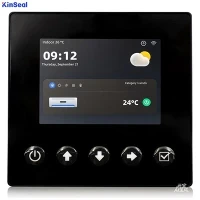


Industrial controller is a kind of electronic equipment used in the field of industrial automation, which realizes the automatic control and management of industrial production process by receiving sensor signals, executing control algorithms and outputting control instructions. Industrial controllers are widely used in machinery manufacturing, chemical industry, electric power, metallurgy, transportation, construction and other fields, is to realize industrial automation and intelligent manufacturing of one of the key equipment.
I. Principle of industrial controller
The basic principle of industrial controller is to utilize computer technology and control theory to monitor and control the industrial production process in real time. Its core is the control algorithm, through the algorithm of the input signal processing, generating output signals to achieve precise control of the production process.
- Input signal processing: industrial controller through the sensor and other equipment to obtain a variety of parameters in the production process, such as temperature, pressure, flow, speed, etc., these parameters are known as input signals.
- Control Algorithm: The industrial controller has built-in or external control algorithms to calculate the optimal control strategy based on the input signals and preset control objectives.
- Output Signal Generation: According to the calculation result of the control algorithm, the industrial controller generates corresponding output signals, such as motor start, stop, speed adjustment, etc.
- Control Execution: The output signals are applied to the production equipment through actuators (e.g. motor drives, valve controllers, etc.) to realize the control of the production process.
II, the classification of industrial controllers
According to the function, structure and application areas, industrial controllers can be divided into the following categories:
- Programmable Logic Controllers (PLC): controllers with programmable functions, widely used in the field of industrial automation.
- Microcontroller: controller based on microcontroller, characterized by small size, low cost and flexible functions.
- Embedded controller: a controller that integrates control algorithms and hardware together, featuring a high degree of integration and customization.
- Distributed Controller: A system consisting of multiple controllers, which can realize distributed control of large-scale production processes.
- Fieldbus Controller: Controller based on fieldbus technology, which can realize high-speed communication and data exchange between devices.
III, the composition of the industrial controller
The industrial controller is mainly composed of the following parts:
- Central processing unit (CPU): the core component of the controller, responsible for executing the control algorithm and processing data.
- Memory: used to store information such as control programs, data and parameters.
- Input/output interface: used to connect sensors, actuators and other devices to realize signal input and output.
- Communication interface: used for data exchange and communication with other controllers or computer systems.
- Power supply module: provides stable power supply for the controller.
- Human-machine interface (HMI): used to display control information and operation interface, convenient for users to monitor and operate.
IV, the application of industrial controller technology
- Control algorithms: industrial controllers use a variety of control algorithms, such as PID control, fuzzy control, neural network control, etc., in order to adapt to different control needs.
- Communication technology: industrial controllers use a variety of communication technologies, such as Modbus, Profibus, EtherCAT, etc., to achieve high-speed communication and data exchange between devices.
- Fault diagnosis: Industrial controller has fault diagnosis function, which can monitor the status of equipment in real time, and find and deal with faults in time.
- Data Acquisition and Processing: The industrial controller has data acquisition and processing functions, which can collect various parameters in the production process in real time and analyze and process the data.
- Human-computer interaction: industrial controllers with human-computer interaction, through the touch screen, keyboard and other equipment to interact with the user to achieve the production process monitoring and control.
V, the development trend of industrial controllers
- Intelligent: with the development of artificial intelligence technology, industrial controllers will be more intelligent, able to achieve adaptive control, predictive control and other functions.
- Integration: industrial controllers will be more closely integrated with other equipment and systems to achieve a highly integrated industrial automation solutions.
- Networking: industrial controllers will rely more on network communication technology to achieve high-speed communication and data exchange between devices.
- Customization: With the diversification of industrial production needs, industrial controllers will pay more attention to customized design to meet the needs of different industries and application scenarios.
- Greening: industrial controllers will pay more attention to energy saving and environmental protection, using low-power design and energy-saving technologies to reduce energy consumption and emissions in the production process.
VI. Conclusion
Industrial controllers, as the key equipment for industrial automation and intelligent manufacturing, are constantly developing and innovating in their principles, classifications, compositions and application technologies. With the progress of science and technology and changes in market demand, industrial controllers will develop in the direction of intelligence, integration, networking, customization and greening, bringing more convenience and benefits to industrial production.