




Programmable logic controllers (PLCs) save time, money and energy in process control systems. They simplify the system. A brief history of manufacturing processes has set the stage for how modern ICs can be used instead of discrete components. These ICs allow for simple system design and extended monitoring to improve the safety of equipment and personnel.
Introduction
Industrial controls, factory automation and PLCs (Programmable Control Logic) do a great job, they save time, material, energy and money. But where do we start? Setting up a complete automated factory is a huge endeavor and some people may give up before they start.
We think back to the explorer in Africa a few years ago who asked local tribesmen, "How does an elephant eat?" The tribesman looked at the famous explorer in amazement and replied, "We eat it like anything else, one bite at a time." Like most large systems, industrial controls consist of many smaller circuits. We'll explore some of these little "bites".
Process Control
The assembly line is a relatively new invention in human history. There may have been many parallel inventions in many countries. We will mention just a few of them in a brief history of the process of the soon-to-be fully automated factory.
Samuel Colt, an American gun manufacturer, demonstrated interchangeable parts in the mid-1800s. Previously, each gun was assembled with individually manufactured parts that were to fit. Mr. Colt showed pieces of ten guns, and then he assembled a gun by grabbing random pieces from a dumpster. In the early twentieth century, Henry Ford expanded mass production techniques. He used fixed assembly stations to move cars from location to location. Employees learned just a few assembly tasks and performed them for days at a time.In 1954, George Devol filed U.S. Patent 2,988,237, which spawned the first industrial robot called the Unimate. By the late 1960s, General Motors was using PLCs (Programmable Logic Controllers) to assemble automotive automatic transmissions. Dick Morley, known as the "father" of the PLC, was involved in the production of GM's first PLC, the Modicon. His U.S. Patent 3,761,893 is the basis for many of today's PLCs.
How simple is process control? Figure 1 shows an ordinary household space heater.
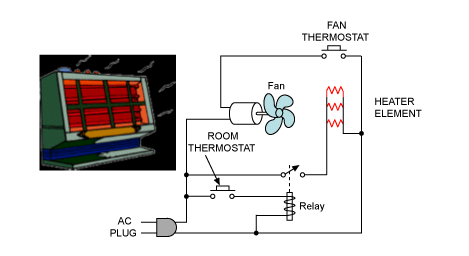
The components of the heater are enclosed in a container, thus making system communication easy. An extension of this concept might be a domestic forced air heater with a remote thermostat. The communication path is only a few meters, and voltage control is usually used.