

Artificial Intelligence has been around since the 1950s, but it's only in the last decade that software developers have been able to build AI into applications as they had hoped. Programming languages are the backbone of AI development projects, and with their help, software developers can create new AI solutions without having to know highly specialized languages that are only used by scientists to communicate with each other.
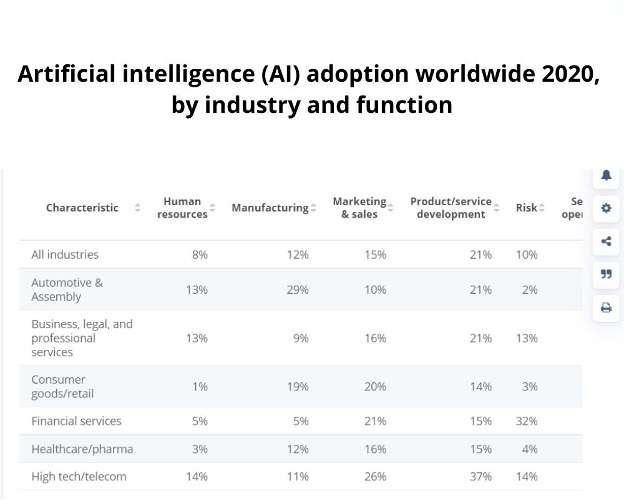
So, how is AI being utilized across industries globally?
In this article, we will cover some of the programming languages that are best suited for AI and the advantages that these languages offer.
1) Python
Python is a great fit for AI because of its powerful data science and machine learning capabilities. Its fast computational power and readability make it a top choice for data scientists. With Python, data scientists can analyze large and complex data sets without worrying about computational speed.
Python has an extensive list of AI-related packages, such as PyBrain, NeuralTalk2, and PyTorch.While TensorFlow is now more widely used than PyTorch, in a few years its popularity may equal that of TensorFlow, thanks to some of the unique features that PyTorch has recently released. Equalization.
These unique features include variable precision in addition to GPU acceleration for deep learning networks, and the latest version of PyTorch also supports multiple devices. This also makes Python easier to learn than C++ or Java (hence its popularity with beginners.) Python is also one of the most popular languages used by professionals.
Since developers are constantly adding new libraries or upgrading existing ones, Python does not lag behind other languages in terms of development. If you know C++ or Java but are not too familiar with neural networks or deep learning methods, in that case, you can easily choose what you need with the help of more than 830 classes in the Numpy library.
Benefits of using Python in AI
- Python has many available libraries that can simplify programming through machine learning.
- If you are working on an AI-based project, then Python libraries can fulfill all your needs.
- As a new developer, it would be more appropriate to learn Python as it has a simpler learning curve and is easier to learn compared to most programming languages.
- It has a powerful machine learning framework, PyBrain, and an active user community where developers can always ask questions and get relevant answers.
2) R Language
R language is an open source programming language that supports statistical analysis and scientific computing.R programming language helps us to generate interactive graphs and other advanced visualizations. It can handle all types of data analysis, from simple linear regression to complex 3D simulations. And anyone can use R.
As a programming language, R is used in a wide range of applications, from statistical computing to machine learning techniques.R is object-oriented programming, highly scalable, capable of performing high-performance computations without interruption, and versatile enough to be used for prediction with a large user base.
Benefits of using R in AI
- The R language is extremely computationally powerful when dealing with large amounts of data.
- The ability of R language to apply mathematical functions also makes it more popular for creating programs with complex decision-making processes.
- R language being an open source tool provides us with the same functionality without charging any fees.
- R language excels at finding new patterns in big data sets. This feature of the R language is especially popular with venture firms that need to analyze customer information and use that information in business marketing and operations.
3) Java
Java is rated as one of the most popular programming languages today. With its object-oriented nature, Java allows us to accomplish tasks effortlessly and quickly; it is easy to use threading and multithreading features in Java as it has built-in support for concurrency.
Many programming languages (such as Ruby on Rails, Python, and Node.js) can be used in conjunction with Java because they all provide comprehensive frameworks to work with them.
Benefits of using Java in AI
- The Java programming language has several features that make it particularly suitable for developing AI programs.Java is a high-level, object-oriented programming language.
- Java is highly readable, a feature that becomes extremely important when developers are often working on a large project with many other team members in different time zones and at different speeds.
- It is a Level 5 programming language that ensures multiple benefits to programmers.
- Since AI applications use machine learning algorithms, writing code from scratch (rather than pre-made libraries) takes longer to compile than Java code.
4) LISP
Originally created in 1958, LISP is a functional programming language, which also means that everything in LISP is an expression. In other words, every line of code does something specific. It may sound a bit complicated at first, but you can write a function to do anything you want, so understanding and building the LISP syntax is easier than learning a whole new language from scratch.
So if you have any kind of programming experience, even if it's Python or C++, then learning LISP will be a no-brainer for you.
Benefits of using LISP in AI
- Almost all major deep learning frameworks rely on LISP for their core operations, which gives us a lot of flexibility when choosing libraries or tools.
- Code executes quickly, without having to consider environmental details.
- It is well suited for abstract operations: simpler models are used to explain deeper models, so programmers do not need to understand how individual components work.
- If a prediction based on the initial model turns out to be wrong, using LISP saves us time later, so rewriting the model becomes relatively simple and doesn't interfere too much with the progress of the work.
5) Prolog
Prolog is a declarative programming language in which we can describe the goal to be achieved without writing the exact implementation. In Prolog, knowledge is represented by facts and rules. Facts are statements about objects, such as that Diligaba is pretty or that Zhang Yining is unbeatable at table tennis.
Rules describe how to infer new facts from existing facts, e.g., if it is said that a person has many children, then the inferred new fact will be that the person has at least 2 children. This is an AI method that allows programmers to spend less time on algorithms and more time thinking about goals.
Benefits of using Prolog in AI
- Prolog can process large amounts of data quickly.
- Prolog has a reputation for its statements and the people who use it are usually smarter than the average programmer.
- Prolog helps increase the speed and accuracy of these programs.
- If you want your program to become perceptive over time (like Skynet), then Prolog may be just what you're looking for! This is because it can modify your program thereby significantly improving its capabilities.
6) C++
C++ is a popular general-purpose programming language. It is a high-level language developed by a team of computer scientists led by Bjarne Stroustrup of Bell Labs. It runs on the Windows, Linux, and Mac OS X operating systems as well as on mobile devices such as smartphones and tablets.C++ has been used to develop games, apps, and graphics programs.
C++ can help us create many other software programs, including those designed for use in artificial intelligence technologies. However, due to its complexity and slow development speed, it is not suitable for tasks such as GUI (graphical user interface) design or rapid prototyping.
Benefits of using C++ in AI
- C++ helps in machine learning prototyping and production because it helps us load complex models into memory easily and quickly.
- It also allows us to quickly experiment with new models or redesign existing models without excessive load times or sacrificing processing power.
- C++ is one of the best choices when developing high-performance code that requires fast access to many data stores.
- If we need to use a certain algorithm or if we are using an application that requires functionality that is not yet built into the language and someone else may have already written what we need, in most cases these modules are open source, meaning that we can just use or modify what someone else has written.
7) Haskell
Haskell is a purely function-based language, which leads to the fact that all expressions in Haskell produce only one value. Since there are no variables, Haskell relies heavily on recursion to create code, but there are some mutable types, especially lists and arrays.
There are complex algorithms that require multiple steps to achieve the desired result, in which case Haskell is an ideal choice. One of its more attractive features is its type system, Haskell has no null values, you can't store anything in a variable and you can't pass any parameters.
Benefits of using Haskell in AI
- Haskell contains a robust type system to avoid multiple type errors in your code.
- While other languages don't easily help us write concise code, Haskell does. Therefore, using Haskell is a good choice for projects that involve a lot of data.
- The simplicity of Haskell also helps us to work on multiple projects at the same time.
- One obvious advantage of using Haskell is its speed. Programs written in Haskell usually run faster than programs written in other programming languages because it is so simple.
8) JavaScript
JavaScript is a widely used programming language that is critical to artificial intelligence, helping us build everything from chatbots to computer vision. With its flexibility and strong developer community, JavaScript has quickly become one of the most popular languages for AI.
Since JavaScript's creation in 1995, we've used it to write many human-like behaviors, such as facial recognition and art generation programs. While organizations will be phasing out some outdated systems, JavaScript will remain an essential skill for any developer who wants to dive into the field of AI.
Benefits of using JavaScript in AI
- JS's high degree of flexibility allows it to be used with the various operating systems, browsers, and virtual machines that developers are using.
- JS does not have to be ported from one system to another as many systems can run on similar architectures.
- JS can be widely used in any field.
- JS is web or browser based and the coding is relatively lightweight without much technical requirements.
9) Julia
AI is a hot area of research, and Julia is well-positioned in this field.Jeff Bezanson, Stefan Karpinski, Viral B. Shah, and their team built this language from scratch based on numerical performance.Julia runs on almost any operating system, and in addition it uses many of the general-purpose coding concepts that we have already mastered general-purpose coding concepts such as loops and conditional statements, so it's easy to learn.
Julia's development environment is not ideal at the moment (there is some development tooling work to be done), but it will get better over time as more and more people build tools around programming languages.
Benefits of using Julia in AI
- It is a high-level, high-performance programming language designed for scientific computing.
- Julia's statements are aesthetically pleasing and concise so that you can focus on solving the problem itself rather than writing new code.
- With Julia, you can generate clearer, faster code with fewer errors while saving time.
- One of the biggest advantages of Julia is that it is open source and free, which means that anyone can access its code.
Summarizing
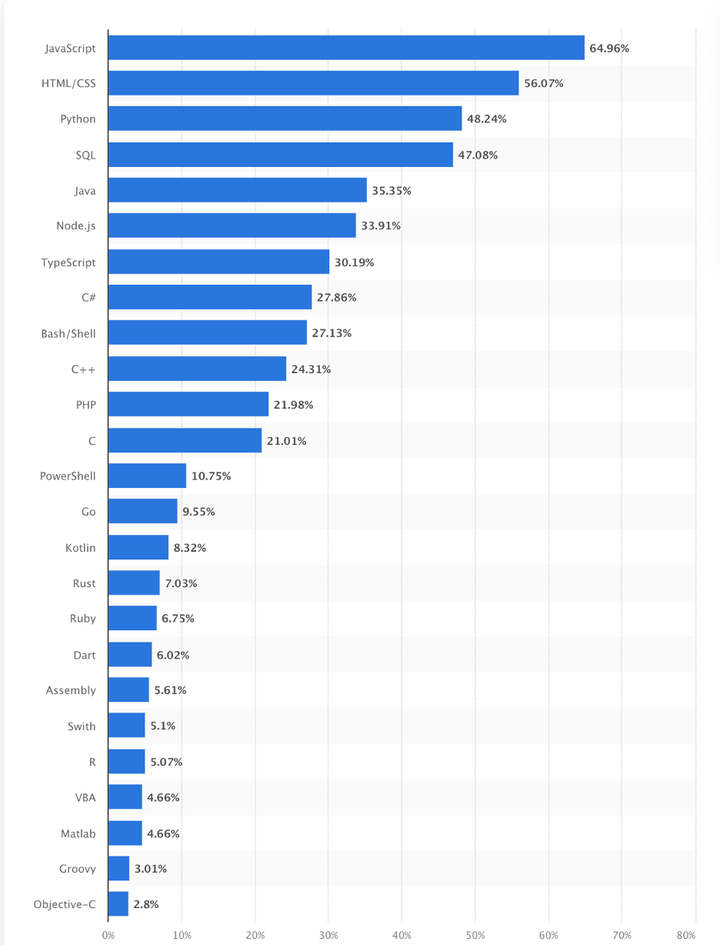
To summarize, there are multiple programming languages we can use to develop AI. No language is perfect, some focus on speed of development, some have the natural advantage of probabilistic modeling, while others work seamlessly with existing software. Which programming language to use ultimately depends on our actual needs. The article concludes by sharing a list of commonly used programming languages in 2021 with extreme percentage information.
Table of Extremely Percentage of Commonly Used Programming Languages in 2021