





Currently, whether in the fields of industrial automation, the automotive industry, or home appliances, various end markets are placing higher demands on the control performance of BLDC motors. Not only do these markets require motors to deliver high efficiency and versatile control capabilities, but they also demand that motors achieve low noise and low vibration while operating at high speeds.
Amid these ever-increasing performance standards, an increasing number of high-performance BLDC motor driver control chips are emerging, driven by two key factors: high market demand and stringent performance requirements.
Many domestic manufacturers have successively launched BLDC motor driver chips and solutions. In terms of performance, these products are on par with those from international manufacturers, offer better value for money, and provide customers with more timely technical support.
Looking at the domestic BLDC chip market, FOC has almost become the standard; based on the application of FOC, manufacturers are integrating more peripheral configurations to gain a competitive edge.
What is FOC?
FOC (Field-Oriented Control), also known as vector control, is currently the best choice for efficiently controlling brushless DC motors (BLDC) and permanent magnet synchronous motors (PMSM).
FOC precisely controls the magnitude and direction of the magnetic field, resulting in smooth motor torque, low noise, high efficiency, and fast dynamic response. It is gradually replacing traditional control methods in many applications and has garnered significant attention in the motion control industry.
Principles of FOC
FOC control primarily requires information such as the motor rotor position, motor speed, and current magnitude as feedback inputs. It involves acquiring the motor phase currents and applying a series of mathematical transformations and estimation algorithms to obtain decoupled, easily controllable feedback quantities.
The controller dynamically adjusts based on the error between the feedback quantities and the target values, ultimately outputting a three-phase sinusoidal waveform to drive the motor.
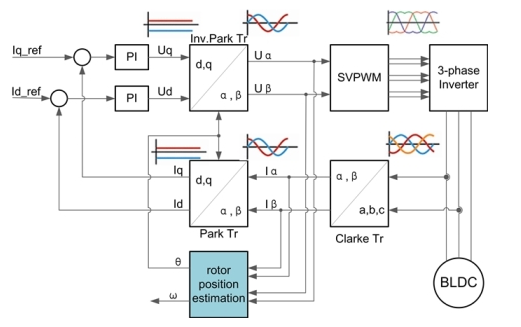 Typical FOC Control Block Diagram
Sensor-Based FOC / Sensorless FOC
For sensor-based FOC, control is simple because the encoder provides feedback on the motor rotor's position; however, it often requires higher control performance.
For sensorless FOC, the control process requires collecting the motor's phase currents and using position estimation algorithms to calculate the rotor position, making it more challenging to control.
However, it features simple wiring, low cost, and high reliability, and can maximize control objectives such as high efficiency, low vibration, low noise, and high response speed. As a result, it has gradually become the mainstream trend in the industry and is widely used in applications such as fans.
Unlike competitors in the industry, who typically implement motor control algorithms through software programming on general-purpose chips (primarily ARM-based), Xinren Technology effectively integrates chip design, motor drive architecture, and motor technology at the underlying architectural level. By adopting a technical approach that embeds algorithms into hardware, the company implements complex motor drive control algorithms at the chip architecture level, resulting in the ME-a motor drive control processor core with proprietary intellectual property.
Technical Application Scenarios
Application scenarios include sensorless/sensor-based BLDC/PMSM motors, three-phase/single-phase induction motors, servo motors, range hoods, indoor air conditioners, ceiling fans, floor fans, vacuum cleaners, hair dryers, industrial fans, water pumps, compressors, electric vehicles, and power tools.
Currently, the industry trend toward single-chip high integration and sensorless FOC control in the BLDC motor drive and control chip sector is already very clear. For BLDC drive and control chip manufacturers, achieving breakthroughs in high efficiency, low power consumption, and stability amid this market growth opportunity will be key to winning market share.